






Introduction
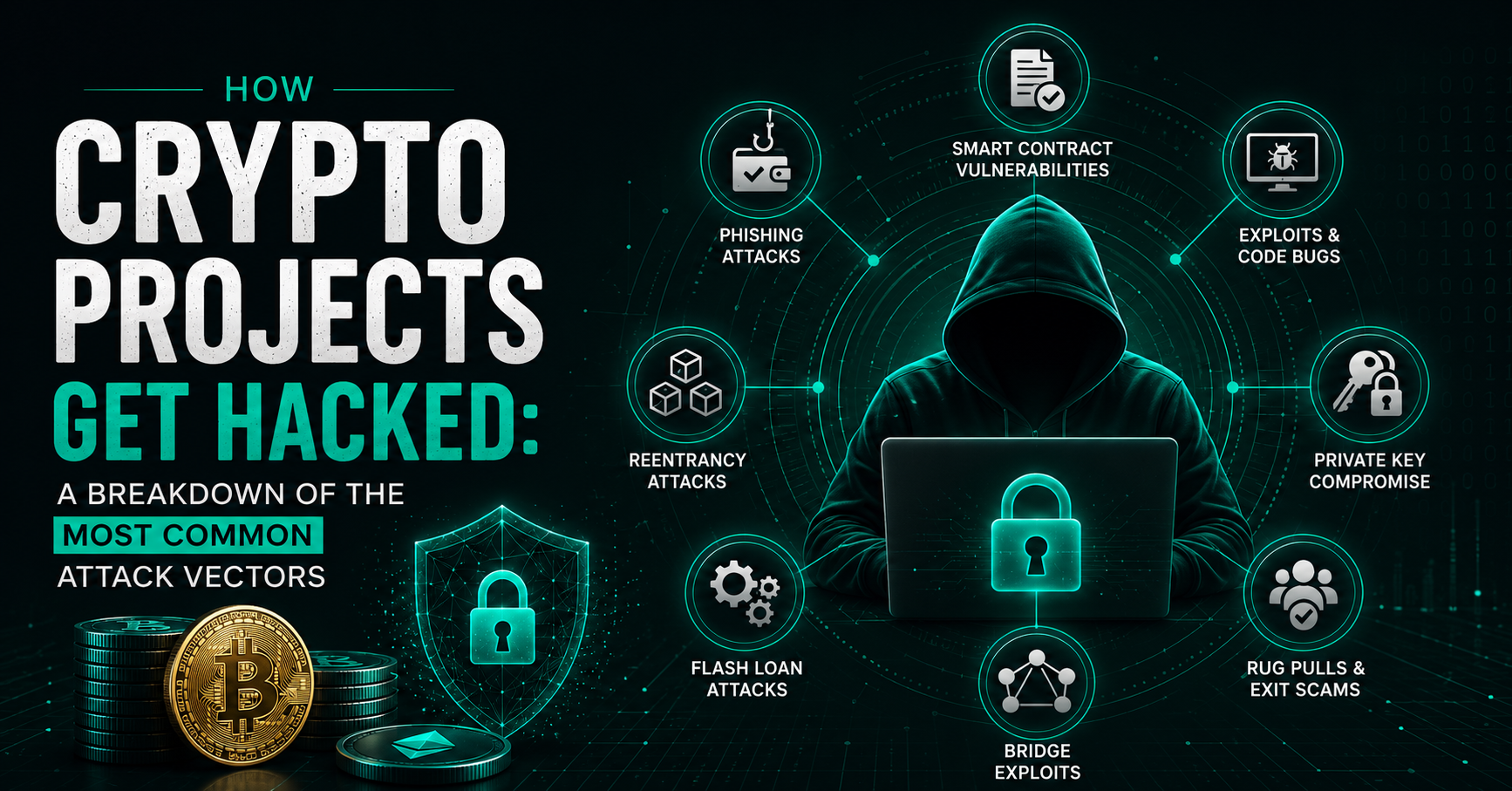
The cryptocurrency industry has grown into a multi-trillion-dollar ecosystem, powering decentralised finance (DeFi), NFTs, blockchain gaming, DAOs, and enterprise Web3 applications. As innovation accelerates, so does the sophistication of cybercriminals targeting blockchain protocols. Over the past few years, billions of dollars in digital assets have been stolen through smart contract exploits, bridge attacks, phishing campaigns, private key compromises, and other security breaches. While each incident may make headlines for different reasons, a closer look reveals a troubling pattern: most successful attacks exploit the same vulnerabilities that have existed for years.
The surprising reality is that crypto hacks are rarely random or entirely new. Attackers do not need to invent groundbreaking techniques when many projects continue to launch with overlooked vulnerabilities, weak security practices, or insufficient testing. Instead, hackers carefully analyse smart contracts, monitor protocol behaviour, identify weak points, and wait for the perfect opportunity to exploit them. In many cases, these attacks are entirely preventable with proper security measures, comprehensive smart contract audits, secure key management, and continuous monitoring.
One of the biggest challenges facing Web3 projects is the speed at which products are developed. Teams often race to launch new features, attract investors, or gain a competitive advantage, leaving security as a secondary priority. Unfortunately, blockchain transactions are irreversible. Once an attacker successfully exploits a vulnerability and transfers funds, recovering those assets is often impossible. Unlike traditional financial systems, there is rarely a central authority capable of reversing fraudulent transactions.
Another reason these attacks continue to succeed is that many projects underestimate the creativity and persistence of attackers. Cybercriminals constantly study previous exploits, share techniques, automate vulnerability discovery, and adapt existing attack methods to new protocols. Rather than searching for completely unknown weaknesses, they frequently rely on proven attack vectors such as reentrancy vulnerabilities, oracle price manipulation, flash loan exploits, access control failures, and compromised administrator credentials. These methods have repeatedly resulted in losses worth millions—and sometimes hundreds of millions—of dollars.
For investors, developers, and project founders, understanding these common attack vectors is essential. Every major exploit provides valuable lessons about blockchain security, secure coding practices, and risk management. Learning how these attacks work enables development teams to build stronger smart contracts, implement layered security controls, and identify vulnerabilities before malicious actors do.
In this guide, we’ll break down the most common ways crypto projects get hacked, explain why these attack vectors continue to succeed, and discuss the best practices that can significantly reduce the risk of exploitation. Whether you’re launching a DeFi platform, NFT marketplace, DAO, blockchain game, or token ecosystem, understanding these recurring threats is one of the most important steps toward protecting your users, your reputation, and your digital assets.
1. Smart Contract Bugs
The most “classic” crypto hack is a flaw baked directly into the code.
- Reentrancy attacks: A malicious contract calls back into the victim contract before its state updates, letting the attacker drain funds repeatedly in a single transaction. This is the same bug class that took down The DAO in 2016, and it still shows up today in projects that don’t follow checks-effects-interactions patterns.
- Integer overflow/underflow: Older Solidity versions (pre-0.8) didn’t automatically revert on overflow, letting attackers wrap balances around to huge numbers.
- Access control mistakes: Functions that should be restricted to an owner or admin are left public, or initialization functions can be called twice, letting an attacker take control of the contract.
- Logic errors in custom math: Especially in AMMs, lending protocols, and staking contracts, subtle rounding or accounting mistakes let attackers mint free tokens or withdraw more than they deposited.
Audits catch many of these, but audits are a snapshot in time — they don’t cover code shipped after the audit, and they can’t catch every edge case, especially in complex, composable DeFi systems.
2. Flash Loan Exploits
Flash loans let anyone borrow huge sums with no collateral, as long as the loan is repaid within the same transaction. This is a legitimate DeFi primitive, but it’s also a favorite hacker tool because it removes the capital requirement for an attack.
A typical flash loan attack:
- Borrow a massive amount of a token.
- Use it to manipulate a price feed or pool balance.
- Exploit a protocol that trusts that manipulated price (e.g., to borrow against inflated collateral or trigger a bad liquidation).
- Repay the loan and walk away with the profit — all in one transaction, one block.
These attacks are especially dangerous because they combine with the next item on this list.
3. Oracle Manipulation
Many protocols rely on price oracles to know the value of assets. If a protocol pulls its price from a single, thinly-traded on-chain pool (instead of a robust, aggregated oracle like Chainlink), an attacker can use a flash loan to briefly distort that pool’s price, then exploit the protocol before the price corrects.
The fix — using time-weighted average prices (TWAPs) or decentralized oracle networks — is well known, but plenty of newer or smaller projects still cut corners here to ship faster.
4. Private Key and Multisig Compromise
Not every hack is clever code exploitation — many are just old-fashioned key theft.
- Compromised signer devices: If a multisig requires 3-of-5 signatures and an attacker compromises enough signer machines (via malware, phishing, or a compromised employee laptop), they can approve a malicious transaction that looks legitimate.
- Poor key management: Private keys stored in plaintext, in cloud storage, in Slack messages, or on a single machine with no hardware wallet are a single point of failure.
- Compromised front-end wallets: Some “hacks” are really just admin wallets getting phished individually.
The Ronin Bridge hack ($625M) and several other massive incidents came down to attackers gaining control of enough validator or multisig keys — not a clever bug in the code at all.
5. Bridge Exploits
Cross-chain bridges are one of the juiciest targets in crypto because they typically hold large pools of locked assets on one side while minting equivalent assets on the other. This creates a huge, centralized honeypot.
Common bridge failure modes:
- Weak or forgeable signature verification for cross-chain messages
- A single compromised validator set (rather than a truly decentralized one) approving withdrawals
- Smart contract bugs in the bridge’s minting/burning logic
Because bridges concentrate so much value, they’ve been the site of some of the largest hacks in crypto history.
6. Governance Attacks
If a protocol’s governance token can be borrowed, bought cheaply, or otherwise acquired in bulk (even temporarily via a flash loan, if voting snapshots aren’t protected), an attacker can push through a malicious proposal — like granting themselves minting rights or draining the treasury — through a vote that looks procedurally legitimate.
This is less about “hacking” in the traditional sense and more about exploiting a protocol’s own decision-making process against itself.
7. Rug Pulls and Insider Exits
Not every incident is an external hack — sometimes the team itself is the threat.
- Hardcoded backdoors: Founders quietly retain a hidden mint function or an admin key that lets them drain liquidity later.
- Liquidity pulls: Anonymous teams pull all liquidity from a DEX pool once enough people have bought in, leaving holders with a worthless token.
- Fake audits or copy-pasted code: Some teams present a report from a nonexistent or reputation-for-hire auditor to convince users of legitimacy.
These are especially common with low-cap tokens and short-lived projects that spin up fast to catch a trend.
8. Social Engineering and Phishing
Even flawless code doesn’t help if a human gets tricked.
- Fake job offers or “collaboration” documents delivered to employees that install malware, giving attackers a foothold to steal keys or credentials
- Discord or Telegram admin account takeovers, used to post fake “mint now” or “claim airdrop” links to a malicious contract
- Fake customer support DMs asking users to “verify” their wallet by connecting it to a malicious site
This category is responsible for some of the highest-value hacks in crypto history precisely because it bypasses code security entirely and targets people instead.
9. Front-End and Supply Chain Attacks
Sometimes the smart contract is fine, but the website users interact with isn’t.
- DNS hijacking: Attackers gain control of a project’s domain and redirect users to a malicious clone that drains connected wallets.
- Compromised dependencies: A malicious npm package or compromised analytics script injected into a project’s front end can silently alter transaction data before a user signs it.
- Malicious wallet-connect prompts: Users are tricked into signing a transaction that looks routine but actually grants token approval or transfers funds to the attacker.
Why These Hacks Keep Happening
Almost every category above has a known, well-documented defense. So why do teams keep getting hit?
- Speed over security: Competitive pressure to ship pushes teams to skip or rush audits.
- Composability risk: DeFi protocols plug into each other, so a vulnerability in one contract can cascade into protocols that depend on it, even if those protocols did everything right themselves.
- Concentrated value, decentralized responsibility: Bridges and multisigs hold enormous value but often have weaker operational security than a traditional bank holding the same amount.
- Humans are the easiest target: It’s often cheaper and easier to phish an employee than to find a zero-day in audited code.
The Takeaway
Most crypto hacks aren’t exotic — they’re variations on a small set of well-understood failure modes: buggy contracts, manipulable oracles, compromised keys, weak bridges, gameable governance, and good old-fashioned social engineering. Protecting a project isn’t about defending against some unknowable future exploit; it’s about rigorously closing the doors that have already been kicked in hundreds of times before.
That’s the mission behind heistproof.ai: helping teams find and close those doors before an attacker does.
Frequently Asked Questions
1. What’s the most common way crypto projects get hacked?
Smart contract bugs (especially reentrancy and access control errors) and private key or multisig compromise are the two most frequent causes, followed closely by bridge exploits and phishing.
2. What is a reentrancy attack?
It’s when a malicious contract calls back into a victim contract before that contract updates its internal balances, letting the attacker withdraw funds repeatedly in a single transaction.
3. Are audited projects still at risk of being hacked?
Yes. Audits are a snapshot in time — they don’t cover code changes shipped afterward and can’t catch every edge case, especially in complex, interconnected DeFi systems.
4. Why are flash loans used in hacks if they’re a legitimate feature?
Flash loans let anyone borrow huge sums with no collateral, as long as it’s repaid in the same transaction. Attackers use that scale to briefly manipulate prices or pool balances, exploit a protocol that trusts those numbers, then repay the loan — all before anyone can react.
5. What is oracle manipulation?
It’s when an attacker distorts the price feed a protocol relies on (often a thinly traded on-chain pool) so the protocol misprices collateral, loans, or trades — usually combined with a flash loan for scale.
6. Why are cross-chain bridges hacked so often?
Bridges concentrate enormous value in one place (locked assets on one chain, minted equivalents on another), making them high-value targets, and many rely on smaller or less battle-tested validator sets than the base chains they connect.
7. What’s the difference between a hack and a rug pull?
A hack exploits a technical or operational flaw from the outside. A rug pull is when the project team itself walks away with funds — often via a hidden admin key or by pulling liquidity — so it’s an insider action, not an external exploit.
8. Can a project be hacked even if its code is perfect?
Yes. Attackers frequently target the humans and infrastructure around a project instead — phishing employees, hijacking a project’s DNS to serve a fake front end, or compromising a software dependency used in the website.
9. What is a governance attack?
It’s when an attacker acquires enough of a protocol’s governance tokens (sometimes just temporarily) to push through a malicious proposal, such as granting themselves minting rights or draining a treasury, through what looks like a legitimate vote.
10. How can crypto projects protect themselves from these attacks?
By combining rigorous, ongoing audits (not just one-time), decentralized and time-weighted price oracles, hardware-backed multisig key management, bug bounty programs, and continuous monitoring — closing the well-known doors attackers keep walking through, which is the core focus of heistproof.ai.