






Introduction
The Web3 industry has made tremendous progress in securing smart contracts, strengthening blockchain infrastructure, and protecting digital assets. Yet despite these advancements, attackers continue to steal millions of dollars from users and projects by exploiting one of the most overlooked parts of the ecosystem—the website and dashboard that users interact with every day.
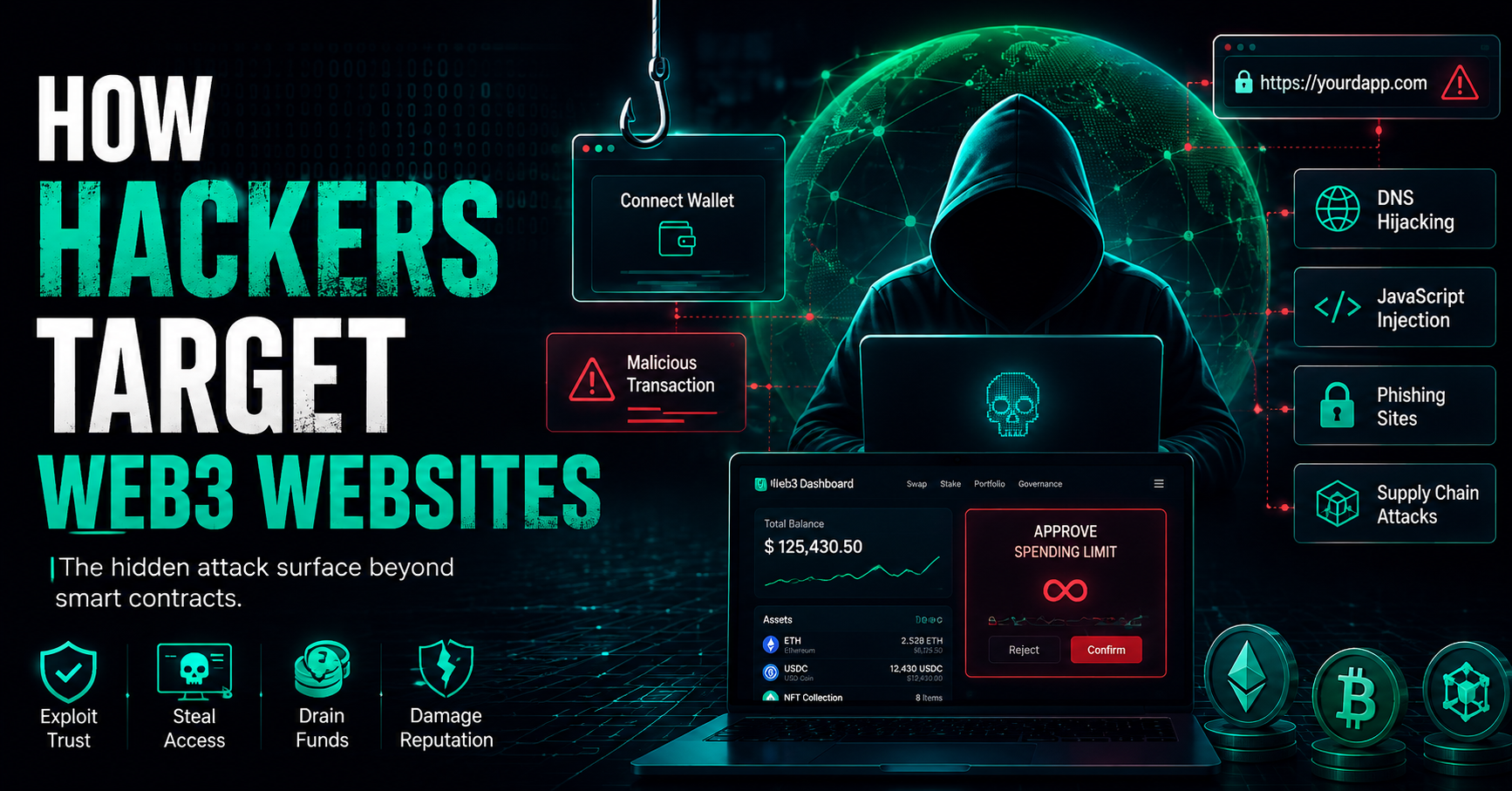
For most users, a Web3 application begins and ends with its frontend. Whether connecting a wallet, swapping tokens, staking assets, minting NFTs, or participating in governance, users rely entirely on what they see on the screen. This makes websites and dashboards an incredibly attractive target for cybercriminals. Even if the underlying smart contracts have been audited and secured, a compromised frontend can manipulate transactions, redirect funds, or trick users into approving malicious requests without altering a single line of blockchain code.
At HeistProof.ai, we believe Web3 security extends far beyond smart contracts. Understanding how attackers compromise websites and dashboards is essential for protecting users, safeguarding assets, and maintaining trust in decentralized ecosystems.
Why Web3 Websites Are Prime Targets for Hackers
Unlike traditional applications, Web3 platforms require users to authorize blockchain transactions directly from their wallets. Every interaction involves a level of trust between the user and the website. Attackers understand that if they can compromise the frontend, they can influence what users approve, often without raising immediate suspicion.
A malicious actor does not always need to exploit a vulnerability in a smart contract to steal cryptocurrency. Instead, they can modify a website so that users unknowingly send assets to attacker-controlled wallets, sign dangerous transactions, or reveal sensitive credentials. Since blockchain transactions are irreversible, even a short-lived compromise can lead to devastating financial losses and permanent reputational damage for the project.
Common Techniques Used to Attack Web3 Frontends
DNS Hijacking
One of the most effective attacks against Web3 websites involves compromising the Domain Name System (DNS). Instead of attacking the application itself, attackers gain access to the domain registrar or DNS provider and redirect visitors to a fraudulent server. Because the fake website often looks identical to the legitimate one, users rarely notice anything unusual. They connect their wallets, approve transactions, and unknowingly send assets directly to attackers. Strong registrar security, multi-factor authentication, DNS monitoring, and registry locks significantly reduce the risk of these attacks.
Compromised Hosting Infrastructure
Many Web3 applications are hosted on cloud platforms such as AWS, Vercel, Netlify, or Cloudflare. If attackers gain access to hosting accounts or deployment credentials, they can replace legitimate frontend files with malicious versions. The blockchain remains secure, but users interact with compromised code that silently changes wallet addresses, injects fake approval requests, or manipulates transaction details. This type of attack highlights why infrastructure security is just as important as blockchain security.
JavaScript Injection Attacks
Modern decentralized applications rely heavily on JavaScript to deliver interactive experiences. Attackers frequently inject malicious scripts into websites through compromised hosting, vulnerable plugins, or third-party libraries. Once executed inside a user’s browser, malicious JavaScript can monitor wallet activity, intercept transaction requests, replace recipient addresses, or display misleading information designed to deceive users. Since these attacks occur in the browser, they often bypass traditional blockchain security tools.
Supply Chain Attacks: Trusting the Wrong Code
Third-Party Dependencies Can Become Attack Vectors
Every modern Web3 application depends on open-source software packages, wallet SDKs, analytics tools, UI frameworks, and external libraries. While these dependencies accelerate development, they also introduce additional security risks. If a commonly used package is compromised, every application that relies on it may unknowingly distribute malicious code to its users.
Supply chain attacks have become increasingly sophisticated because attackers understand that compromising a single dependency can affect thousands of projects simultaneously. Regular dependency audits, software composition analysis, and strict version control are essential to reducing this risk.
Phishing Websites That Look Identical
Fake Domains Continue to Fool Users
Creating convincing phishing websites has become easier than ever. Attackers register domains with slight spelling variations, alternative extensions, or additional words that resemble legitimate projects. These websites often appear in sponsored advertisements, fake social media posts, Discord announcements, Telegram groups, or phishing emails.
Once users connect their wallets, the fraudulent website requests malicious approvals or prompts them to sign dangerous transactions. Because the design closely mirrors the legitimate platform, even experienced users can become victims.
Wallet Connection Attacks
Every Wallet Prompt Deserves Careful Review
Many users have developed the habit of clicking “Connect Wallet” and approving requests without carefully reviewing the details. Attackers exploit this behavior by presenting wallet prompts that request unlimited token approvals, contract permissions, or delegated access.
Some malicious approvals do not transfer funds immediately. Instead, they grant attackers ongoing permission to spend tokens later without additional confirmation. Users may believe nothing happened because their wallet balance remains unchanged, only to discover days or weeks later that their assets have been drained.
Dangerous Signature Requests
Not Every Signature Is Harmless
A common misconception in Web3 is that signing a message is always safe because no cryptocurrency moves immediately. Unfortunately, many blockchain protocols use cryptographic signatures to authorize future actions without requiring an on-chain transaction at the time of signing.
Attackers frequently disguise these signature requests as harmless verification prompts while actually obtaining authorization for NFT transfers, token approvals, permit signatures, or delegated permissions. Educating users about signature security is becoming just as important as protecting private keys.
Cross-Site Scripting (XSS) Vulnerabilities
User Input Can Become a Security Risk
Many Web3 dashboards allow users to submit profiles, governance proposals, marketplace listings, NFT descriptions, or comments. Without proper validation and sanitization, attackers can inject malicious JavaScript that executes inside other users’ browsers.
Cross-Site Scripting attacks may steal authentication tokens, hijack user sessions, redirect visitors to phishing pages, or manipulate dashboard content. Even mature Web3 projects have experienced XSS vulnerabilities, demonstrating the importance of secure coding practices and rigorous frontend testing.
Administrative Dashboard Attacks
Privileged Accounts Are High-Value Targets
Behind every decentralized application are administrators who manage infrastructure, monitor services, publish updates, configure settings, and oversee deployments. These privileged accounts represent some of the most valuable targets for attackers.
Cybercriminals often use phishing emails, credential stuffing, malware, or social engineering to compromise administrator accounts. Once inside, they may modify website content, deploy malicious frontend code, alter API configurations, or disrupt critical services. Implementing hardware security keys, role-based access controls, and continuous monitoring helps reduce these risks.
API Security Is Just as Important
Hidden Backend Services Can Expose Sensitive Data
Every Web3 frontend communicates with backend APIs that provide portfolio information, token balances, NFT ownership records, pricing data, governance information, and user profiles. Poorly secured APIs can expose sensitive information or allow unauthorized actions through broken authentication, excessive permissions, insecure object references, or inadequate rate limiting.
Attackers frequently automate API scanning to identify weaknesses that can be exploited at scale. Comprehensive API testing and continuous monitoring should therefore be a core part of every Web3 security program.
Continuous Deployment Creates New Risks
Secure Development Pipelines Matter
Modern development teams deploy new features rapidly through automated CI/CD pipelines. While continuous deployment improves agility, it also creates opportunities for attackers. If deployment credentials, GitHub repositories, environment variables, or build systems are compromised, malicious code can be distributed automatically to every user without immediately triggering suspicion.
Organizations should protect deployment infrastructure with strong authentication, secret management, code signing, peer reviews, and deployment verification procedures.
Best Practices for Securing Web3 Websites and Dashboards
Protecting a Web3 website requires a defense-in-depth approach rather than relying on a single security control. Organizations should secure domain registrars with registry locks and multi-factor authentication, continuously monitor DNS records, implement Content Security Policy (CSP) headers, use Subresource Integrity (SRI) for third-party scripts, regularly audit software dependencies, protect cloud infrastructure, secure CI/CD pipelines, enforce least-privilege access, deploy Web Application Firewalls (WAFs), conduct regular penetration testing, monitor website integrity, and train employees to recognize phishing and social engineering attacks. Just as importantly, every project should maintain a well-defined incident response plan to quickly detect, contain, and recover from website compromises.
Conclusion
Smart contracts are only one layer of Web3 security. The website and dashboard that users interact with every day are equally critical and often represent the easiest entry point for attackers. A compromised frontend can manipulate transactions, steal approvals, redirect funds, or destroy user confidence without exploiting a single blockchain vulnerability.
At HeistProof.ai, we help Web3 organizations secure the entire attack surface—not just their smart contracts. From frontend security assessments and infrastructure reviews to penetration testing, API security, cloud hardening, and continuous monitoring, our approach focuses on protecting every layer that users depend on. In an ecosystem where trust is everything, securing your website and dashboard is no longer optional—it is a fundamental requirement for protecting your protocol, your users, and your reputation.
Frequently Asked Questions
1. Why do hackers target Web3 websites instead of smart contracts?
Hackers often target Web3 websites because compromising the frontend is usually easier than exploiting audited smart contracts. A compromised website can trick users into signing malicious transactions, approving unlimited token access, or connecting to attacker-controlled wallets without changing the blockchain itself.
2. What is a Web3 frontend attack?
A Web3 frontend attack occurs when attackers compromise a decentralized application’s website or dashboard. They may inject malicious JavaScript, modify wallet prompts, or redirect users to phishing pages to steal cryptocurrency or sensitive information.
3. How does DNS hijacking affect Web3 projects?
DNS hijacking allows attackers to redirect users from a legitimate Web3 website to a fake version that looks identical. Users may unknowingly connect their wallets and approve malicious transactions, resulting in stolen digital assets.
4. What are wallet approval scams?
Wallet approval scams trick users into granting unlimited spending permissions or signing malicious transactions. Instead of stealing funds immediately, attackers gain permission to transfer assets later without requiring additional approval.
5. Can audited smart contracts still be exploited through a website?
Yes. Even if smart contracts are fully audited, a compromised website can manipulate transaction details, replace wallet addresses, or display fake information, causing users to authorize harmful transactions.
6. How can Web3 projects secure their websites?
Projects should implement multi-factor authentication, DNS security, Content Security Policy (CSP), Subresource Integrity (SRI), secure CI/CD pipelines, dependency scanning, Web Application Firewalls (WAFs), regular penetration testing, and continuous monitoring to protect their websites.
7. What is a supply chain attack in Web3?
A supply chain attack occurs when attackers compromise a third-party library, SDK, or software dependency used by a Web3 application. Malicious code is then distributed to every project relying on that compromised component.
8. How can users protect themselves from Web3 phishing websites?
Users should always verify the website URL, bookmark official project websites, avoid clicking links from unsolicited messages, carefully review wallet approval requests, and use browser security extensions or phishing detection tools whenever possible.
9. Why are Web3 admin dashboards attractive targets?
Administrative dashboards control website deployments, infrastructure, user management, and application settings. If attackers compromise administrator accounts, they may modify the frontend, inject malicious code, or disrupt platform operations.
10. Why is frontend security important for Web3 projects?
Frontend security is critical because it protects the primary interface users trust. A secure website prevents phishing, malicious transaction manipulation, credential theft, and unauthorized wallet approvals, helping maintain user trust and protect digital assets.