






Introduction
Web3 promised a new internet — one owned by users, governed by communities, and built on transparent, trustless infrastructure. But there’s an uncomfortable irony at the heart of this movement: an industry built on the idea of “trustlessness” has struggled, again and again, to earn actual trust. Billions of dollars have been lost to hacks, exploits, rug pulls, and smart contract vulnerabilities since the early days of decentralized finance. Every major exploit doesn’t just cost a project its treasury — it costs the entire ecosystem a piece of its credibility.
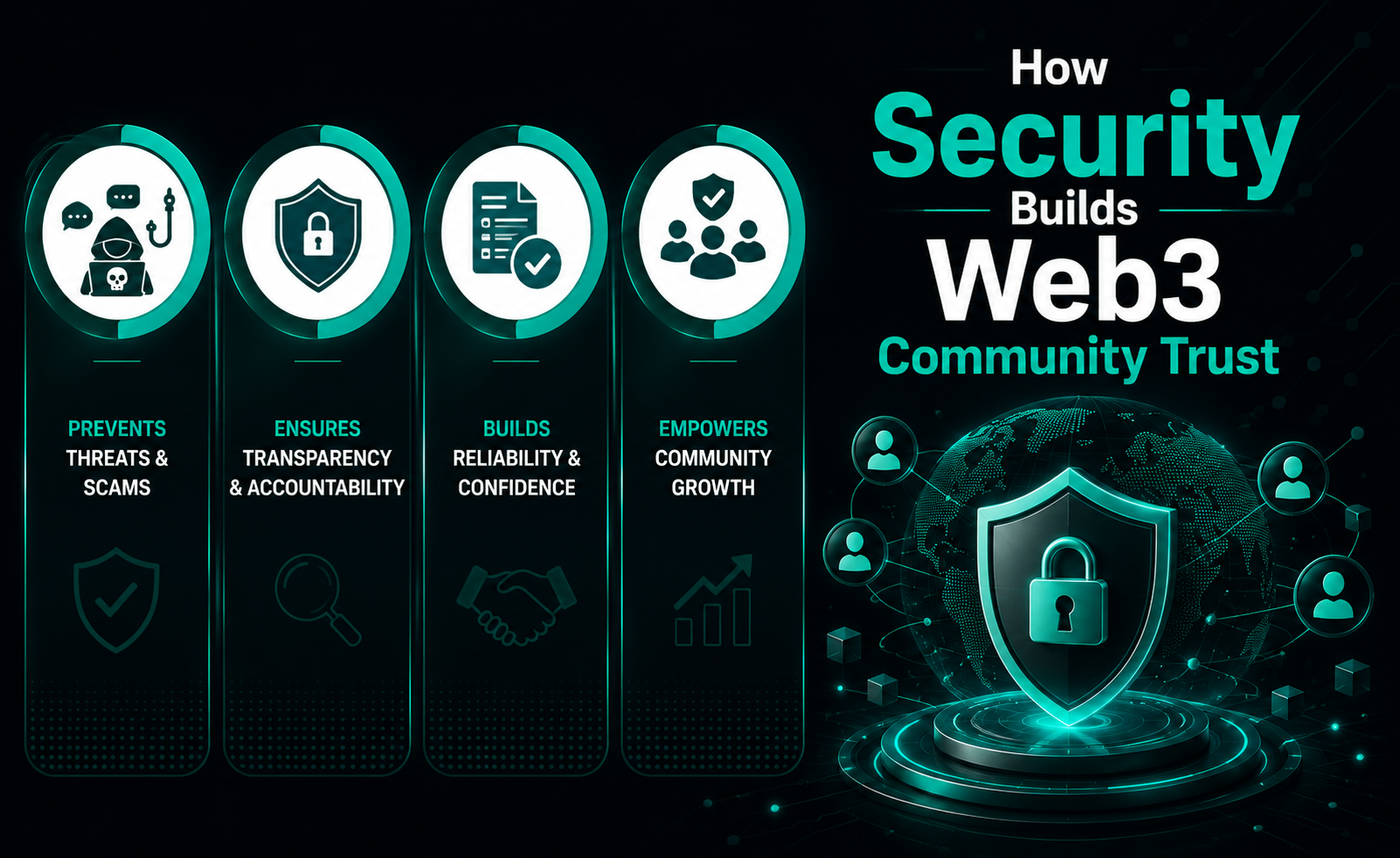
For any Web3 project, whether it’s a DeFi protocol, an NFT marketplace, a DAO, or a Layer 2 network, security isn’t a technical checkbox. It’s the foundation on which community trust is built, maintained, and eventually turned into long-term loyalty. In this post, we’ll explore exactly how security functions as a trust-building mechanism in Web3, why it matters more than marketing or hype, and what projects can do — practically — to make security a core part of their community strategy.
Why Trust Is Harder to Earn (and Easier to Lose) in Web3
In traditional finance, trust is often institutional. Banks are insured, regulated, and backed by governments. In Web3, there is no safety net. If a smart contract gets exploited, funds are often gone permanently. There’s no customer service line to call, no FDIC insurance, and no way to reverse a malicious transaction once it’s confirmed on-chain.
This absence of a backstop makes trust in Web3 fundamentally different — and fundamentally fragile. Communities don’t just trust a brand or a marketing promise; they trust code, infrastructure, and the people who built it. That trust is earned through consistent, verifiable behavior over time, and it can evaporate instantly the moment something goes wrong.
This is why security incidents hit Web3 projects so much harder than a typical Web2 data breach. A hacked SaaS company might issue a public apology and move on. A hacked DeFi protocol often sees its token price collapse, its community disperse, and its reputation permanently damaged — sometimes beyond recovery.
Security as the First Layer of Trust
Long before a community engages with governance, tokenomics, or roadmap discussions, they’re evaluating one thing at a subconscious level: is this safe to use? Security is the first filter through which every Web3 user — from retail participants to institutional players — evaluates a project.
1. Smart Contract Audits Signal Seriousness
A completed, published smart contract audit tells the community that a project has invested real resources into verifying its code. It signals that the team isn’t just moving fast and hoping for the best — they’re taking the responsibility of handling user funds seriously. Communities have become increasingly sophisticated at reading audit reports, checking for unresolved critical findings, and comparing audit firms’ reputations. Projects that skip this step, or quietly bury flawed audit results, are quickly called out by vigilant communities.
2. Transparency Reduces Uncertainty
Security transparency — publishing audit results, disclosing known risks, running public bug bounty programs, and communicating clearly during incidents — reduces the uncertainty that erodes trust. When a community understands what protections are in place and what risks remain, they can make informed decisions. Silence, vague language, or hidden vulnerabilities do the opposite: they breed suspicion, even when nothing has actually gone wrong yet.
3. Proactive Monitoring Shows Ongoing Commitment
Security isn’t a one-time event; it’s continuous. Projects that implement real-time threat monitoring, anomaly detection, and automated response systems demonstrate that they view security as an ongoing responsibility rather than a launch-day formality. This kind of infrastructure — the kind platforms like HeistProof.ai are built to provide — gives communities confidence that a project is watching for threats around the clock, not just reacting after damage is done.
The Trust Multiplier Effect
Security doesn’t just prevent losses — it actively multiplies trust in ways that compound over time. Here’s how that plays out across a project’s lifecycle.
Early Stage: Attracting the Right Users
In a crowded market, security-conscious users specifically seek out projects with strong security postures. Sophisticated DeFi users, for example, often check for audits, bug bounty programs, and insurance coverage before ever depositing funds. Projects that lead with security messaging — rather than treating it as an afterthought — attract a more discerning, higher-quality user base from day one.
Growth Stage: Retaining Users Through Volatility
Crypto markets are volatile, and Web3 projects face constant scrutiny. During periods of market stress, security track record becomes a major differentiator. Communities remember which projects have never been exploited, which projects responded transparently to incidents, and which projects quietly patched vulnerabilities without drama. This memory becomes a form of social proof that keeps users engaged even when token prices dip.
Maturity Stage: Becoming the Trusted Standard
Over time, projects with consistently strong security track records become reference points for the entire ecosystem. Other projects integrate with them because they’re considered safe. Institutional capital flows toward them because due diligence teams have flagged them as low-risk. Community members become advocates, recommending the project to others precisely because of its security reputation. At this stage, security has transformed from a defensive necessity into a genuine competitive advantage.
What Happens When Security Fails
It’s worth examining the flip side. When a Web3 project suffers a major security incident, the damage extends far beyond the immediate financial loss.
- Token price collapse: Markets react almost instantly to exploit news, often wiping out significant value within hours.
- Community exodus: Active community members — the moderators, contributors, and evangelists who sustain a project’s culture — often disengage after a breach, especially if communication is poor.
- Reputational contagion: In a small, interconnected industry, a security failure at one project can cast doubt on partners, integrations, and even the broader category of protocol it belongs to.
- Regulatory attention: High-profile hacks often attract regulatory scrutiny, which can create additional compliance burdens for the project and its peers.
- Difficulty rebuilding: Even projects that recover technically often struggle to rebuild community trust. Users who were burned once tend to remain cautious indefinitely, and rebuilding a reputation can take years — far longer than it took to lose it.
This asymmetry — trust is slow to build and fast to destroy — is precisely why proactive security investment delivers such outsized returns for Web3 projects willing to make it a priority.
Practical Ways Web3 Projects Can Use Security to Build Trust
Understanding the why is only half the equation. Here’s how projects can translate security investment into genuine, visible community trust.
1. Publish Comprehensive, Independent Audits
Work with reputable, independent security firms and publish full audit reports publicly — not just summaries. Communities value seeing the details, including what issues were found and how they were resolved.
2. Run ongoing bug bounty programmes.
A well-funded, actively managed bug bounty program signals that a project welcomes scrutiny rather than fearing it. It also creates a financial incentive for white-hat researchers to report vulnerabilities responsibly instead of exploiting them.
3. Implement Real-Time Monitoring and Threat Detection
Continuous, automated monitoring of smart contracts, wallets, and on-chain activity allows teams to detect and respond to suspicious behavior before it escalates into a full-blown exploit. This kind of infrastructure — real-time alerting, anomaly detection, and rapid incident response — is exactly the gap that tools like HeistProof.ai are designed to close for Web3 teams that can’t realistically monitor everything manually.
4. Communicate Clearly and Quickly During Incidents
No security posture is perfect, and incidents can still happen. What separates trusted projects from distrusted ones is how they respond. Clear, honest, timely communication — even when the news is bad — preserves far more trust than silence or spin.
5. Build Security Into Governance
DAOs and community-governed projects can formalize security as a governance priority: allocating treasury funds specifically for audits and monitoring, creating security councils, and giving the community visibility into security-related decisions.
6. Educate the Community
Security isn’t only the project’s responsibility — users also need to protect themselves from phishing, wallet compromises, and social engineering. Projects that invest in ongoing security education build a more resilient, trust-oriented community overall.
7. Obtain Insurance or Coverage Where Possible
Where available, protocol insurance or coverage funds give users an additional layer of confidence, signaling that the project has planned for worst-case scenarios rather than assuming they’ll never happen.
Security and Community Trust Are the Same Investment
Perhaps the most important mindset shift for Web3 teams is recognizing that security spending and community-building spending aren’t separate line items — they’re deeply intertwined. A marketing campaign can generate short-term attention, but a strong security track record generates durable, compounding trust that no amount of advertising can replicate.
As the Web3 space matures, users are becoming more discerning. The projects that will define the next phase of this industry won’t necessarily be the loudest or the flashiest — they’ll be the ones that users, developers, and institutions genuinely trust to protect their assets and data. Security is how that trust gets built, one audit, one transparent disclosure, one incident-free quarter at a time.
Conclusion
At HeistProof.ai, we believe that effective exchange security is never the result of a single tool, audit, or policy. It is the outcome of multiple security layers working together—secure custody architecture, hardened infrastructure, rigorous smart contract reviews, strong access controls, continuous monitoring, and a well-practiced incident response strategy.
The reality is that attackers are constantly evolving, but most successful breaches still exploit preventable weaknesses. A missed configuration, an exposed credential, an unpatched vulnerability, or an overlooked process can be enough to compromise an entire platform. That is why security must be treated as an ongoing operational discipline rather than a one-time compliance exercise.
Organizations that consistently stay ahead of threats are those that continuously assess risk, validate controls, test their defenses, and adapt to new attack techniques. Regular audits, penetration testing, employee security training, threat intelligence monitoring, and proactive remediation should be embedded into everyday operations.
Ultimately, trust is one of the most valuable assets any exchange can earn. By implementing a comprehensive, defense-in-depth security strategy and continuously improving it over time, exchanges can better protect user funds, maintain regulatory confidence, and build a resilient foundation for long-term growth in the digital asset ecosystem.
HeistProof.ai helps organizations identify vulnerabilities before attackers do, enabling stronger security, reduced risk, and greater confidence in an increasingly complex threat landscape.
Frequently Asked Questions
1. Why is security so important for Web3 projects specifically?
Because Web3 transactions are typically irreversible and there’s no central authority to recover lost funds, security failures have permanent, immediate consequences that don’t exist in traditional finance.
2. How does a smart contract audit help build community trust?
An audit shows the community that independent experts have reviewed the code for vulnerabilities, reducing uncertainty and demonstrating that the project takes user fund safety seriously.
3. What is a bug bounty program, and why does it matter?
A bug bounty program financially rewards security researchers for responsibly disclosing vulnerabilities, encouraging discovery and fixing of issues before malicious actors can exploit them.
4. Can a project recover community trust after a hack?
Yes, but it takes time, transparency, and consistent follow-through. Projects that communicate honestly, compensate affected users where possible, and strengthen security afterward have the best chance of rebuilding trust.
5. What role does real-time monitoring play in Web3 security?
Real-time monitoring detects suspicious on-chain activity as it happens, allowing teams to respond quickly and potentially prevent an exploit from causing significant damage.
6. Is a single audit enough to guarantee a project’s security?
No. Security is an ongoing process. Code changes, new integrations, and evolving attack techniques mean projects need continuous monitoring and periodic re-audits, not just a one-time review.
7. How can everyday users evaluate whether a Web3 project is secure?
Users can check for published audits, active bug bounty programs, transparent communication history, and whether the team has a track record of responding well to past incidents.
8. Does security investment pay off financially for Web3 projects?
Yes. Strong security track records attract more users, retain them longer, and often lead to institutional partnerships, making security a long-term driver of growth rather than just a cost center.
9. What should a project do if a vulnerability is discovered?
Disclose it promptly and clearly, patch it as quickly as possible, communicate the timeline and impact to the community, and, where relevant, compensate affected users.
10. How does HeistProof.ai help Web3 projects with security?
HeistProof.ai provides continuous monitoring, threat detection, and rapid response tools designed to help Web3 teams identify and address risks before they escalate into costly exploits, supporting the kind of ongoing security posture that builds lasting community trust.