






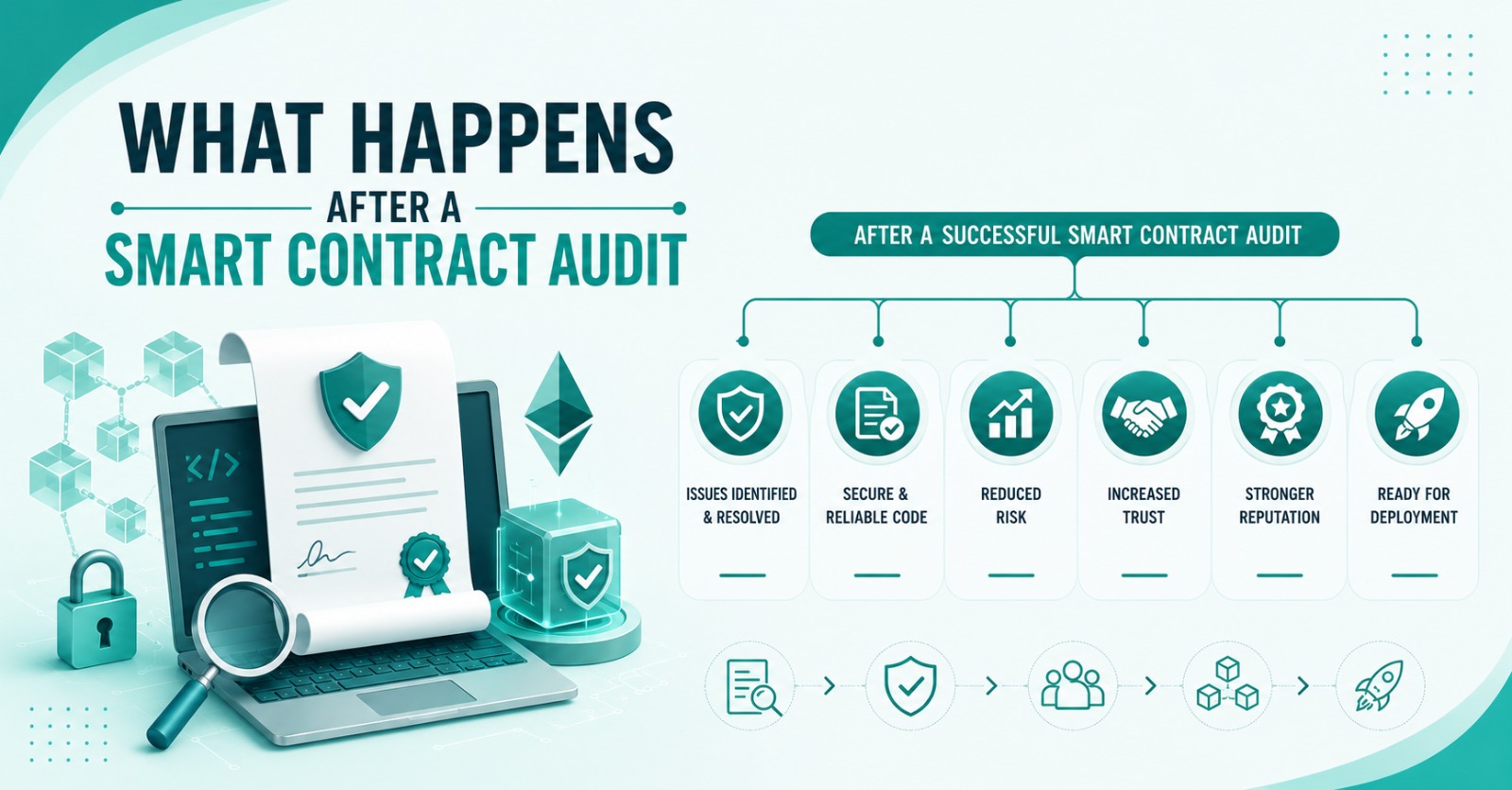
What Happens After a Smart Contract Audit?
For most teams building on-chain, the smart contract audit feels like the finish line. Weeks of back-and-forth with auditors, a stack of findings to fix, and finally—a clean report. Champagne emoji in the group chat. Ready to launch.
But here’s the uncomfortable truth the industry doesn’t talk about enough: an audit is not a finish line. It’s a checkpoint. Some of the most expensive hacks in crypto history happened to protocols that had already been audited—sometimes by more than one firm. The audit report didn’t fail; the process after it did.
This post walks through what should actually happen once the audit report lands in your inbox, and why the weeks and months following that report matter just as much as the audit itself.
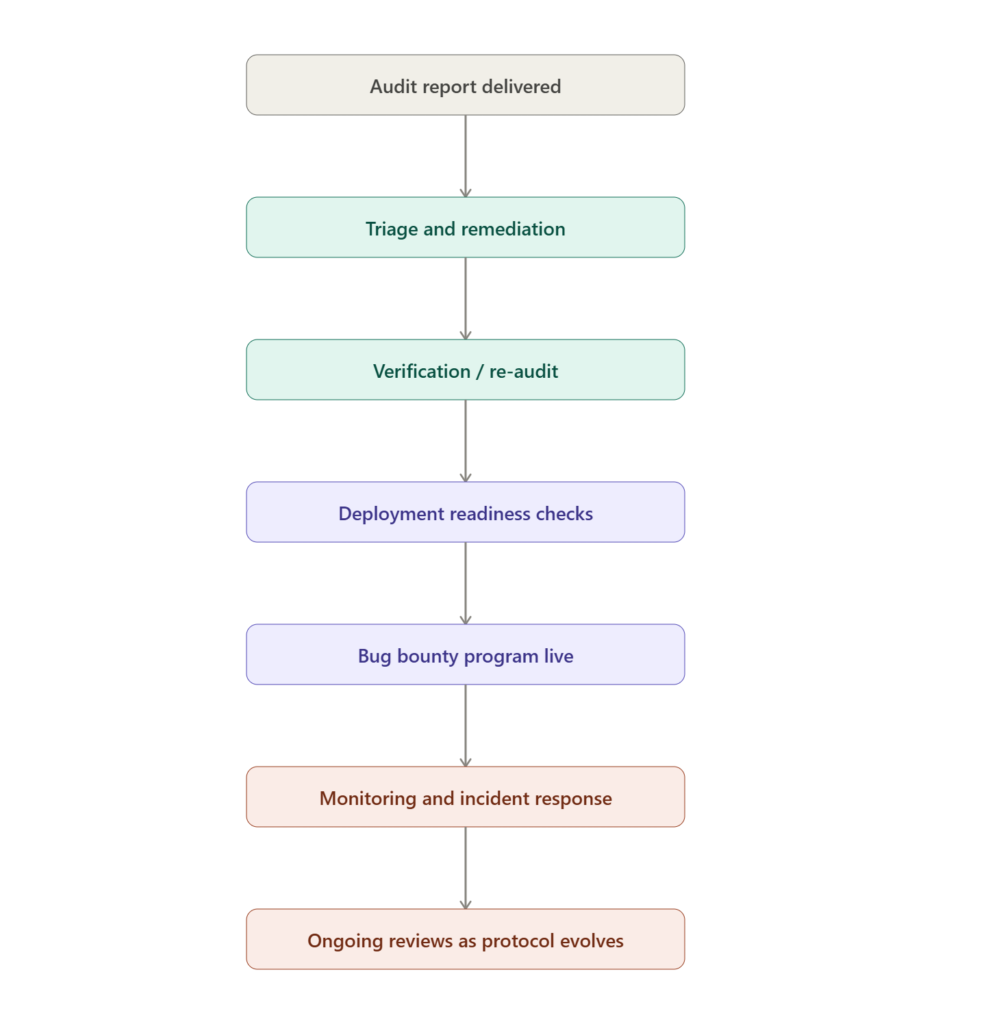
1. The Report Isn’t a Pass/Fail Grade
The first mental shift teams need to make is understanding what an audit report actually is. It’s not a certificate. It’s a structured, time-boxed opinion from a group of security researchers about the state of your code at a specific commit hash, under a specific set of assumptions, within a specific engagement scope.
That means a few things:
- Scope matters. If the audit covered your core vault contracts but not your governance module, the governance module is unaudited—full stop. Read the scope section of your report line by line.
- Severity isn’t binary. Findings are usually bucketed into critical, high, medium, low, and informational/gas-optimization categories. Critical and high findings block launch. Medium and low findings are judgment calls. Informational findings are often skipped entirely, which is itself a risk decision worth documenting.
- Assumptions are load-bearing. Auditors often note trust assumptions—”admin key is assumed honest,” “oracle is assumed non-manipulable within X window.” If those assumptions don’t hold in production, the audit’s conclusions don’t hold either.
Treat the report as a snapshot of risk, not a guarantee of safety.
2. Triage and Remediation
Once findings are in hand, the real work starts: triage. A good remediation process looks like this:
Step one: categorize every finding. For each item, the team decides to fix, mitigate, accept, or dispute. “Accept” is a legitimate outcome for low-severity or theoretical findings, but it needs sign-off from someone with authority to accept risk—not just a developer quietly ignoring a line item.
Step two: fix in a separate branch with tests. Every remediation should come with a regression test that fails on the vulnerable code and passes on the fix. This isn’t busywork—it’s what lets your team (and the auditor) verify the fix actually closes the gap rather than just changing the symptom.
Step three: track everything in a remediation log. A simple table mapping finding ID → severity → fix commit → status → verified-by is worth its weight in gold later, especially if regulators, insurers, or investors ask “how was this handled?”
Teams that skip structured remediation tend to make a specific mistake: they patch the reported bug but introduce a new one in the process, because the fix was rushed and untested. This is one of the most common causes of post-audit incidents.
3. The Re-Audit or Verification Pass
Here’s where many teams cut corners, and it’s the single biggest gap between “audited” and “actually secure.” Fixing findings without a verification pass is like a doctor diagnosing a problem, prescribing surgery, and never checking whether the surgery worked.
A proper post-remediation review includes:
- Auditors re-reviewing each fixed finding against the new code, not just taking the team’s word for it.
- A fresh look for any new issues introduced by the fixes themselves.
- An updated report, often shorter, confirming which findings are resolved, which are mitigated, and which remain open with team acknowledgment.
Some engagements price this in as part of the original scope. Others treat it as a separate, smaller re-audit. Either way, budget for it up front. Skipping this step to save time or money is the single most common reason “audited” protocols still get hacked—the vulnerability the auditor found either wasn’t actually fixed, or the fix broke something else that nobody caught.
4. Publishing the Report (and What to Redact)
Transparency builds trust, but publishing an audit report isn’t a simple copy-paste job.
Before making a report public, teams should:
- Confirm the auditor’s permission to publish and follow their branding/attribution requirements.
- Remove or redact any details that could function as a roadmap for exploitation of unresolved findings.
- Include a clear summary at the top: number of findings by severity, remediation status, and links to the fixed commits.
- Note the audited commit hash explicitly, so anyone reading the report can verify it matches what’s actually deployed.
A public report with unresolved critical findings and no context is worse than no report at all—it invites exactly the wrong kind of attention. If issues remain unresolved for legitimate reasons (e.g., a known trust assumption baked into the design), say so plainly rather than burying it in an appendix.
5. Deployment Readiness Checks
Passing an audit doesn’t automatically mean the contract that gets deployed is the contract that was audited. This sounds obvious, but deployment mismatches are a recurring cause of incidents.
Before deploying to mainnet, verify:
- Commit hash match. The deployed bytecode should correspond exactly to the audited source, not a “small tweak” made after the report.
- Constructor and initialization parameters. Wrong parameters (fee percentages, admin addresses, oracle addresses) can turn a secure contract into an exploitable one without changing a single line of code.
- Deployment scripts themselves. These are often unaudited but hold enormous power—get this wrong and you’ve deployed something subtly different from what was reviewed.
- Multisig and timelock configuration. If your security model depends on a 3-of-5 multisig with a 48-hour timelock, confirm that’s exactly what’s live, with the correct signer set.
Bytecode verification against the audited source, published on a block explorer, gives the community and any future security researcher a way to independently confirm what’s live matches what was reviewed.
6. Bug Bounties: The Audit’s Long Tail
No audit—no matter how thorough—can catch everything. Audits are time-boxed; attackers are not. This is why a bug bounty program should launch alongside, or shortly after, deployment.
A well-run bug bounty program includes:
- Clear, public scope defining which contracts and vulnerability classes are in scope.
- A tiered payout structure matching the severity of the finding—competitive enough that a rational actor would rather report the bug than exploit it.
- A responsible disclosure policy with a defined response SLA, so researchers know they’ll get a timely reply.
- A safe harbor clause protecting good-faith researchers from legal threats.
Bug bounties effectively extend your audit indefinitely, crowdsourcing the ongoing search for issues at a fraction of the cost of a full re-audit, and they’ve caught vulnerabilities that formal audits missed on more than one occasion.
7. Monitoring and Incident Response
An audit examines code; monitoring watches behavior. These are complementary, not redundant.
Post-launch, teams should have:
- On-chain monitoring for anomalous transactions—unusual withdrawal volumes, price deviations from oracles, sudden TVL drops, or governance proposals with suspicious payloads.
- Alerting infrastructure that pages a human immediately, not a Slack message that sits unread over a weekend.
- A documented incident response plan—who has pause authority, what the communication tree looks like, and what the first hour of response actually involves. Drafting this after an incident starts is too late.
- Circuit breakers or pause mechanisms, if your architecture supports them, that can be triggered fast without needing a full governance vote.
Some of the worst outcomes in DeFi history weren’t caused by the initial exploit alone—they were made worse by slow, disorganized response in the hours immediately after.
8. Ongoing Security as Protocols Evolve
Protocols aren’t static. New features, upgrades, and integrations all expand the attack surface, and each one effectively invalidates parts of the original audit’s assumptions.
A mature security posture treats every material change as requiring its own review:
- New contract deployments or upgrades get audited before launch, not after.
- Integrations with new external protocols (new oracles, new bridges, new liquidity venues) are reviewed for how they interact with existing trust assumptions.
- Periodic re-audits are scheduled even without major changes, since the broader threat landscape (new exploit techniques, new tooling) evolves independently of your code.
Some teams formalize this into a security calendar: quarterly reviews of high-value contracts, mandatory audits before any upgrade proposal reaches governance, and an annual comprehensive review of the full system.
9. Documentation and Institutional Memory
One underrated part of post-audit life is documentation. Team members leave, priorities shift, and the reasoning behind a specific design decision or accepted risk can get lost. Maintaining a living security document—covering trust assumptions, known limitations, remediation history, and monitoring setup—means new team members (and new auditors) aren’t starting from zero.
This documentation also matters for external stakeholders. Investors, insurers, and integration partners increasingly ask for evidence of an ongoing security process, not just a single audit PDF from launch day.
Conclusion
A smart contract audit is one of the most important steps in securing a Web3 project, but it should never be viewed as the finish line. The real value of an audit comes from what follows—fixing every identified vulnerability, validating the changes through re-audits, deploying securely, continuously monitoring on-chain activity, running bug bounty programmes, and reassessing security whenever the protocol evolves.
In the rapidly changing blockchain ecosystem, security is not a one-time checklist; it is an ongoing commitment. Every contract upgrade, feature release, or protocol integration introduces new risks that require continuous attention.
At Heistproof.ai, we believe that effective blockchain security extends far beyond delivering an audit report. Our approach combines comprehensive smart contract audits, manual code reviews, automated analysis, penetration testing, post-audit verification, and continuous security guidance to help Web3 projects build with confidence. Whether you’re preparing for mainnet deployment or maintaining a live protocol, our team works alongside you to reduce risk, strengthen trust, and protect your users and digital assets.
A secure protocol isn’t defined by the audit report it receives—it’s defined by the security practices it maintains every day.
Frequently Asked Questions
1. Does passing a smart contract audit mean the protocol is 100% safe?
No. An audit reduces risk by catching known vulnerability patterns within a defined scope and timeframe, but it can’t guarantee the absence of all bugs, especially novel exploit techniques or issues outside the audited scope.
2. How long after an audit should a protocol wait before deploying?
There’s no fixed timeline—it depends on how many findings need remediation. What matters more than speed is completing a verification pass on all fixes before mainnet deployment, even if that adds a few extra days or weeks.
3. Who should verify that audit findings were actually fixed?
Ideally the original auditing firm, since they have the deepest context on the finding. If a re-audit isn’t feasible, at minimum a second independent reviewer should confirm the fix, backed by regression tests.
4. Is it normal for a protocol to have unresolved low-severity findings at launch?
Yes, this is common and often acceptable, as long as the decision to accept the risk is documented, reviewed by someone with authority to accept it, and disclosed transparently rather than hidden.
5. Do audited protocols still need a bug bounty program?
Yes. Bug bounties cover the gap between an audit’s fixed scope/timeframe and the ongoing, unlimited effort of the wider security community, and they’ve caught issues that formal audits missed.
6. What’s the difference between an audit and ongoing monitoring?
An audit is a point-in-time code review; monitoring is continuous observation of live on-chain activity. They serve different purposes and neither replaces the other.
7. Should every contract upgrade be re-audited?
Any material change to logic, especially anything touching funds, access control, or oracle integrations, should go through review before deployment. Minor, non-functional changes may not need a full re-audit, but the decision should be deliberate, not skipped by default.
8. How often should a mature protocol schedule re-audits?
Many teams adopt a cadence of reviewing high-value contracts periodically (e.g., annually) in addition to auditing every major upgrade, since the threat landscape evolves even when the code doesn’t.
9. Why do audited protocols still get hacked?
Common causes include unresolved or improperly verified findings, deployment mismatches between audited and live code, unaudited scope (like admin scripts or new integrations), and novel attack vectors the audit’s scope or timeframe didn’t cover.
10. Should audit reports always be made public?
Transparency is generally good for trust, but reports should be reviewed before publishing to ensure any unresolved critical issues aren’t disclosed in a way that invites exploitation, and the audited commit hash should always be included so readers can verify it matches what’s deployed.