






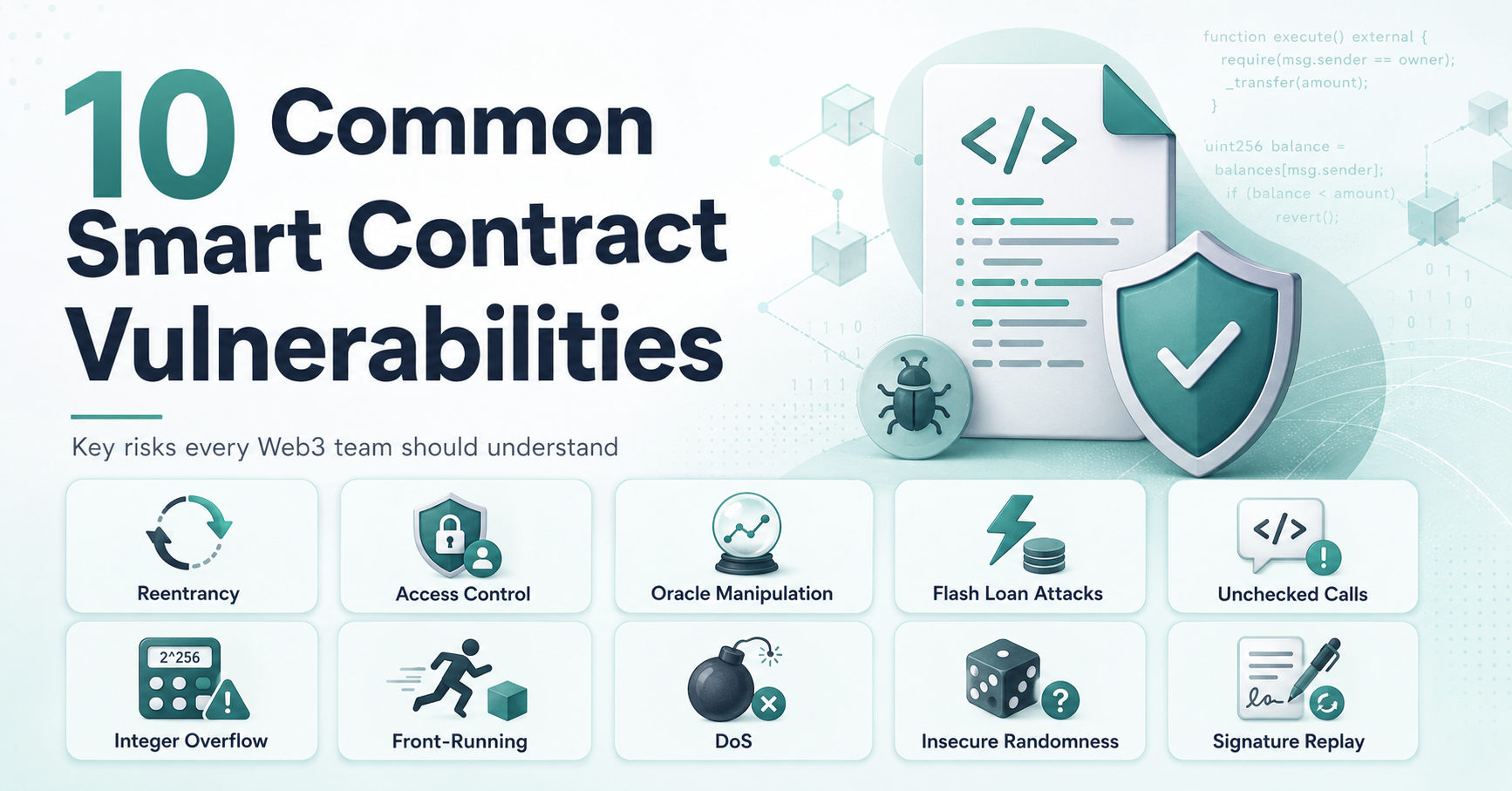
Smart contracts power many important Web3 activities, including token transfers, staking, lending, liquidity pools, governance, NFT ownership, and digital payments. Because these contracts often manage real financial value, even a small coding mistake can create a serious security risk. Once a vulnerable contract is deployed, attackers may exploit it to steal funds, manipulate prices, block withdrawals, or take control of important protocol functions.
At HeistProof, we believe security should be considered throughout the development process, not only after an incident occurs. Understanding the most common smart contract vulnerabilities can help Web3 teams reduce risks, protect user funds, and build more reliable protocols.
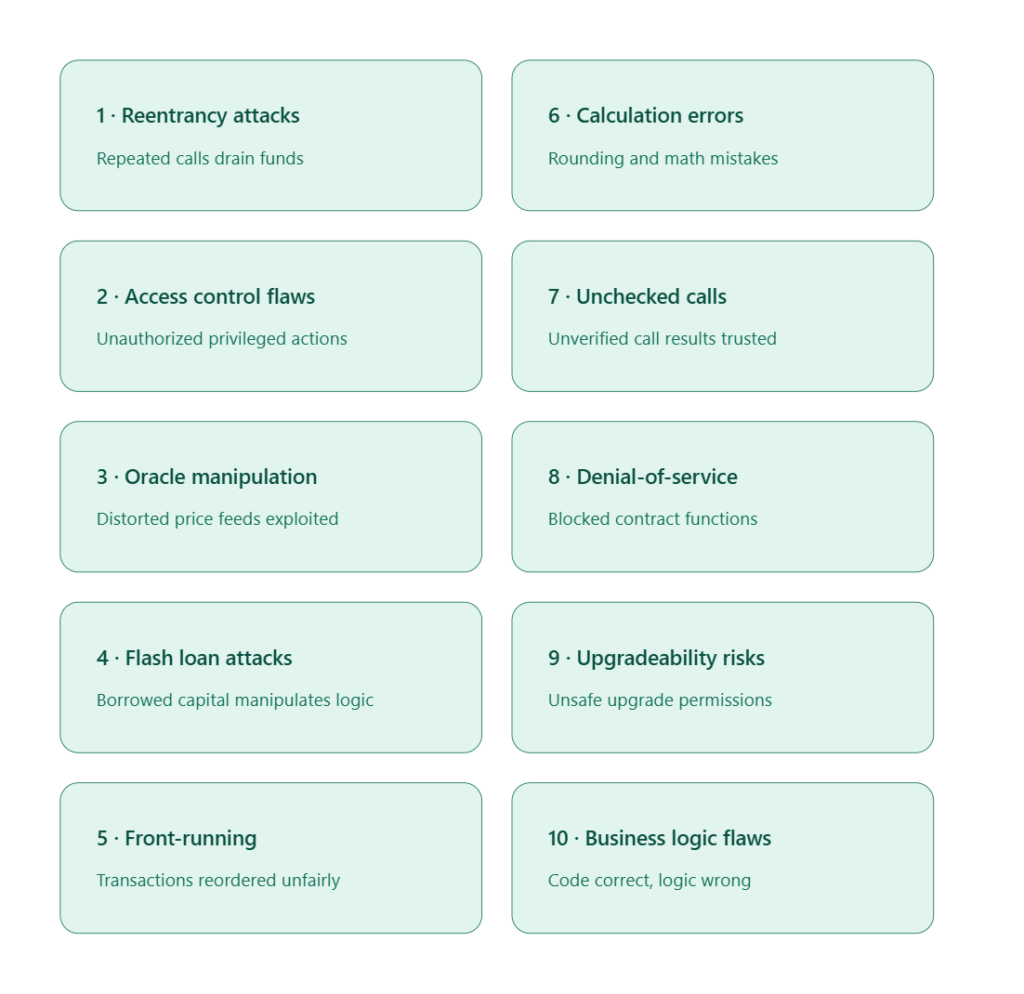
1. Reentrancy Attacks
A reentrancy attack occurs when a malicious contract repeatedly calls a function before the original transaction has been fully completed. This often happens when a smart contract sends funds before updating the user’s balance. An attacker may use this weakness to trigger the withdrawal function several times and withdraw more funds than they are entitled to receive. Developers can reduce this risk by updating balances before making external calls, following the checks-effects-interactions pattern, and using reliable reentrancy protection.
2. Access Control Vulnerabilities
Access control determines who is allowed to perform sensitive actions within a smart contract. If permissions are weak or incorrectly configured, an unauthorised user may be able to mint tokens, withdraw funds, pause the protocol, modify fees, upgrade contracts, or take ownership of the system. Critical functions should only be available to approved addresses or clearly defined roles. Multisignature wallets and timelocks can also add an extra layer of protection for important administrative actions.
3. Oracle Manipulation
Many DeFi protocols rely on external price data provided by oracles. If an attacker can manipulate the price source, they may be able to borrow more than they should, trigger unfair liquidations, withdraw excess collateral, or purchase assets at an incorrect value. This risk is especially high when a protocol depends on a single price source or a market with limited liquidity. Using trusted oracle providers, multiple data sources, time-weighted average prices, and price-deviation checks can help reduce the possibility of manipulation.
4. Flash Loan Attacks
Flash loans allow users to borrow large amounts of cryptocurrency without providing collateral, as long as the loan is repaid within the same transaction. Although flash loans are legitimate financial tools, attackers can use them to temporarily gain access to large amounts of capital. This capital may then be used to manipulate token prices, influence governance votes, exploit lending calculations, or drain liquidity pools. The flash loan itself is not normally the vulnerability. The weakness is usually found in the protocol’s pricing system, economic design, or business logic.
5. Front-Running and Transaction Manipulation
Pending blockchain transactions can often be viewed before they are confirmed. An attacker may identify a valuable transaction and submit another transaction with a higher fee so that theirs is processed first. This is known as front-running. It can affect token trades, NFT purchases, auctions, liquidations, and other time-sensitive activities. Protocols can reduce this risk by using private transactions, transaction batching, slippage protection, or commit-reveal mechanisms.
6. Integer and Calculation Errors
Smart contracts regularly perform calculations involving balances, interest rates, fees, rewards, token prices, and collateral values. Incorrect mathematical logic can result in rounding errors, incorrect rewards, unfair fees, or unexpected account balances. Modern Solidity versions provide protection against many overflow and underflow problems, but custom formulas, decimal handling, and unchecked code still require careful security review. Even a small calculation error can create a major financial imbalance within a protocol.
7. Unchecked External Calls
Smart contracts often communicate with other contracts, tokens, wallets, and third-party protocols. These external calls may fail, return unexpected information, or behave maliciously. If the original smart contract does not properly verify whether an external call was successful, it may continue operating with incorrect data. This can result in failed transfers, inconsistent balances, locked assets, or broken protocol logic. Developers should carefully manage all external interactions and confirm the success or failure of every important call.
8. Denial-of-Service Vulnerabilities
A denial-of-service vulnerability can prevent users or administrators from accessing important smart contract functions. An attacker may deliberately cause a transaction to fail, create a process that consumes too much gas, or block a function that depends on another user or external contract. For example, if one failed payment causes an entire reward distribution process to stop, a malicious participant may be able to block payments for everyone. Smart contracts should avoid unnecessary loops, unsafe external dependencies, and processes where one failure can stop the complete system.
9. Upgradeability Risks
Upgradeable smart contracts allow development teams to modify protocol logic after deployment. This can be useful for fixing errors, improving performance, and adding new features. However, upgradeable contracts also introduce additional security risks. Problems may occur when storage layouts are changed incorrectly, upgrade permissions are not protected, initialisation functions can be called more than once, or a compromised administrator replaces the original contract logic. Upgrade processes should use strict access controls, multisignature approval, timelocks, and independent security reviews.
10. Business Logic Vulnerabilities
Business logic vulnerabilities occur when a smart contract follows the written code correctly but does not behave as the project intended. These vulnerabilities are particularly difficult to detect because automated tools may not understand the protocol’s financial model, rules, or expected user behaviour. Examples include incorrect reward distribution, bypassed withdrawal limits, manipulated voting power, unfair fee calculations, and users combining valid actions to exploit the system. Finding these weaknesses requires experienced manual review, threat modelling, and a clear understanding of how the protocol is expected to operate.
Why Automated Scanning Is Not Enough
Automated security tools are useful for identifying known coding patterns and common technical problems. However, they cannot fully understand how a complex protocol should work. They may overlook economic attacks, unusual interactions between contracts, governance risks, custom financial logic, and unexpected user behaviour.
A reliable smart contract audit should combine automated testing with detailed manual review. Experienced security researchers examine the code from an attacker’s perspective and test how different functions, permissions, integrations, and user actions could be misused.
How HeistProof Helps Protect Web3 Projects
At HeistProof, we help Web3 teams identify smart contract vulnerabilities before attackers can exploit them. Our audit approach combines manual code review, automated vulnerability testing, access-control analysis, business-logic testing, external integration review, economic attack modelling, clear reporting, and fix verification.
Our goal is not simply to provide an audit badge or deliver a report. We help development teams understand the risks within their code, correct security weaknesses, and improve the overall reliability of their protocol. By identifying vulnerabilities before deployment, projects can reduce financial risk, protect their users, and launch with greater confidence.
Final Thoughts
Smart contract vulnerabilities can cause serious financial, operational, and reputational damage. Reentrancy attacks, weak access controls, oracle manipulation, flash loan exploits, calculation errors, upgradeability risks, and business logic failures are among the most important threats Web3 teams need to consider.
Security should not be treated as a one-time task completed immediately before launch. It should be included throughout development, testing, deployment, monitoring, and future upgrades. A continuous approach to security helps projects adapt to new threats while maintaining the confidence of their users and stakeholders.
At HeistProof, we help Web3 teams identify vulnerabilities before attackers do, strengthen their smart contracts, and build more secure protocols.
Protect the code. Protect the protocol. Protect user trust.
Frequently Asked Questions
1. What is a reentrancy attack? It occurs when a malicious contract repeatedly calls a function before the original transaction completes, often exploiting contracts that send funds before updating balances — allowing attackers to withdraw more than they’re entitled to.
2. How can developers prevent reentrancy attacks? By updating balances before making external calls, following the checks-effects-interactions pattern, and using reliable reentrancy protection mechanisms.
3. What happens when access control is misconfigured? An unauthorized user may be able to mint tokens, withdraw funds, pause the protocol, modify fees, upgrade contracts, or take ownership of the system entirely.
4. Why are oracles a common target for attackers? Many DeFi protocols rely on external price data, and if that price source is manipulated, attackers can borrow more than they should, trigger unfair liquidations, or purchase assets at incorrect values — especially with single-source or low-liquidity feeds.
5. Are flash loans themselves a vulnerability? Not usually. Flash loans are legitimate financial tools, but attackers can use the temporary capital they provide to manipulate prices, influence governance votes, or drain liquidity pools by exploiting weaknesses in a protocol’s pricing or economic design.
6. What is front-running in the context of smart contracts? It’s when an attacker spots a pending, valuable transaction and submits their own with a higher fee so it processes first — affecting trades, NFT purchases, auctions, and liquidations.
7. Do modern Solidity versions eliminate calculation errors? They protect against many overflow and underflow issues, but custom formulas, decimal handling, and unchecked code still require careful manual review to catch rounding errors or reward miscalculations.
8. What is a denial-of-service vulnerability in smart contracts? A flaw that lets an attacker block important functions — for example, by causing one failed payment to halt an entire reward distribution process for all users.
9. Why do upgradeable contracts carry extra risk? Incorrect storage layout changes, unprotected upgrade permissions, repeatable initialization functions, or a compromised administrator can all let someone replace the original contract logic.
10. Why can’t automated tools catch business logic vulnerabilities? Because the code executes exactly as written — the flaw is in a mismatch between the code and the protocol’s intended behavior, which requires experienced manual review and threat modeling to identify, not pattern-matching scanners.